Discovery Engagements for Systems, Data and AI

Understand your current landscape, identify practical opportunities and define a clear route forward before committing to delivery.

We help organisations bring structure to complex systems, data, documents and workflows. The result is an evidence-based roadmap that supports better decisions, clearer priorities and lower delivery risk.

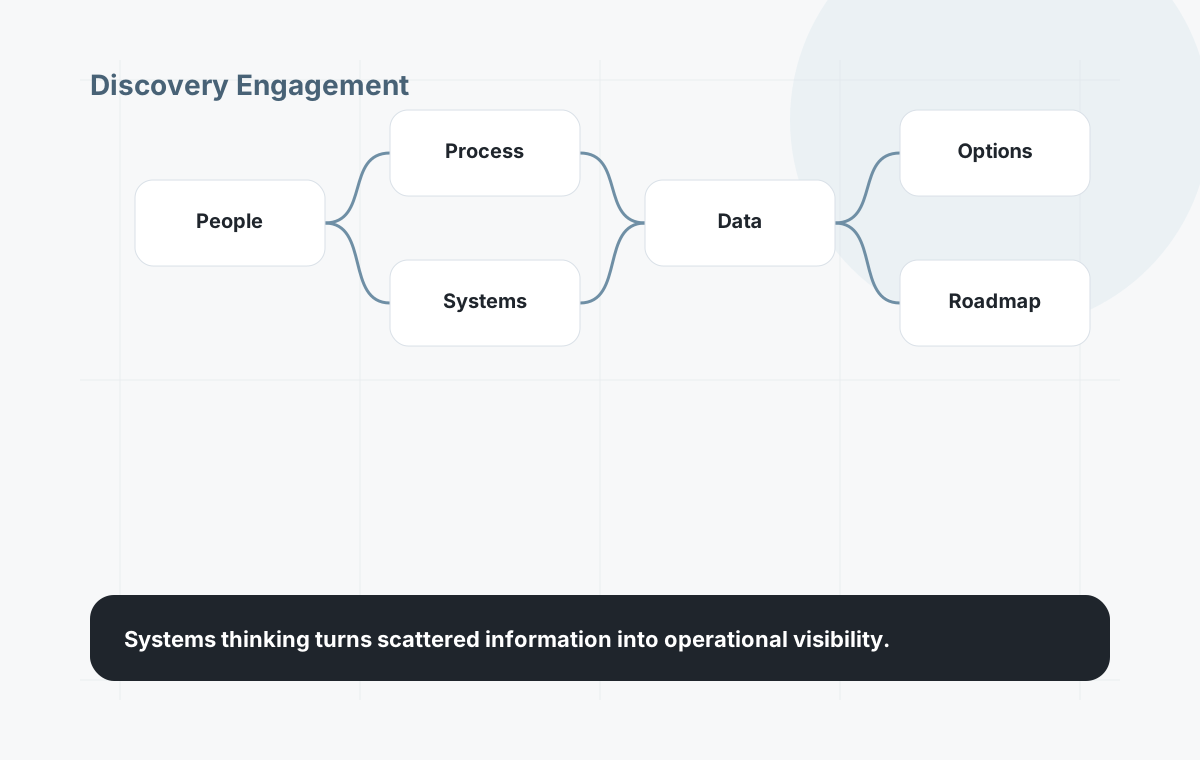
Diagram showing systems, data, processes, documents and governance being mapped into an evidence-based discovery roadmap.

Why discovery matters

Complex problems rarely have simple starting points.

When systems, data and processes evolve over time, it becomes difficult to see where information is held, how work really happens, which risks matter most and which improvements will deliver measurable value.

Jumping straight into delivery can create unnecessary complexity or lead to the wrong solution. A focused discovery engagement gives stakeholders a shared understanding of the current state and a practical basis for deciding what to do next.

It is particularly useful when the organisation needs to compare options, build confidence, assess technology choices or create a clear business case before committing to implementation.

When it makes sense

You may need discovery when the route forward is not yet clear.

Discovery is most valuable when there are multiple possible answers, competing stakeholder views, unclear requirements or important operational risks to understand before delivery starts.

Several systems are involved

Information, data and workflow steps sit across Microsoft 365, file stores, line-of-business systems, spreadsheets, legacy platforms or local team processes.

Processes are inconsistent

Different teams, departments or sites handle similar work in different ways, making it hard to standardise, automate or govern the process.

The technology route is uncertain

You need to compare options such as Microsoft 365 improvement, Power Platform automation, bespoke software, integration, AI or process redesign.

Manual work is creating risk

Teams rely on manual searching, copying, checking, approvals, spreadsheets, emails or undocumented knowledge to keep important work moving.

Governance needs strengthening

Permissions, classification, retention, auditability, reporting or compliance controls need to be better understood before a solution is designed.

Stakeholders need evidence

Senior leaders need a clear explanation of the current position, realistic solution options, trade-offs, effort and expected benefits.

What we help you understand

Clarity across systems, data, processes and governance.

Discovery is not just a technical audit. We look at how people, platforms, information and controls work together in practice — and where the biggest opportunities exist.

  • Where information is stored and how it moves between teams, systems and repositories.
  • How core processes work in reality, including manual steps, handovers, workarounds and bottlenecks.
  • How documents and records are created, reviewed, stored, searched, prepared and controlled.
  • Where data quality, duplication, ownership or visibility issues are creating operational friction.
  • How governance, permissions, retention, audit and compliance controls are applied today.
  • Which improvements are likely to deliver the most value with the least unnecessary disruption.

Discovery focus areas

A structured view of the current landscape.

Systems and platforms

Review the tools, platforms and applications involved in the process, including Microsoft 365, operational systems, legacy tools and data repositories.

Data and information

Map where information is held, how it is accessed, how reliable it is and where better visibility or integration may be needed.

Processes and workflows

Understand how work actually moves through teams, including ownership, approvals, handoffs, exceptions and local variations.

Documents and records

Assess how documents are created, reviewed, version controlled, redacted, approved, retained and prepared for internal or external use.

Governance and compliance

Review permissions, classification, retention, auditability, evidence capture and compliance requirements as part of the overall solution direction.

Automation and AI

Identify where workflow automation, intelligent search, document classification, extraction or summarisation could reduce effort without weakening control.

Our approach

Structured, practical and focused on decisions.

We adapt the discovery to your organisation and the level of certainty you need. The aim is to create enough evidence to make good decisions — not to produce documentation for its own sake.

  1. Frame the engagement — agree stakeholders, objectives, constraints, success measures and the areas that need investigation.
  2. Assess the current state — review systems, tools, repositories, data flows, workflows, documentation and governance controls.
  3. Map the process and evidence — build a shared picture of how work actually happens and where effort, delay or risk is created.
  4. Identify opportunities — prioritise improvements across workflow automation, integration, Microsoft 365, governance, AI and bespoke software.
  5. Define realistic options — set out practical routes with trade-offs, dependencies, complexity, cost considerations and expected outcomes.
  6. Roadmap the next steps — provide phased recommendations, quick wins, delivery priorities and an implementation route that can be acted on.

Technology, but not technology-first

Grounded in real platforms and proven delivery routes.

Discovery helps you decide which route is most sensible before committing to a platform, build or procurement path.

Microsoft 365 and SharePoint

Assess how Microsoft 365, SharePoint, Teams and content structures can support more controlled information and document workflows.

Power Platform automation

Identify practical opportunities for forms, approvals, routing, notifications, dashboards and workflow automation using Power Platform where appropriate.

Purview and governance

Consider classification, retention, records, audit, eDiscovery and compliance requirements as part of the future information architecture.

Azure and integration

Review where Azure, APIs, data platforms, search or integration layers may be needed to connect systems and improve visibility.

AI-assisted processes

Explore where AI could support discovery, classification, extraction, summarisation, triage or response preparation with suitable controls.

Bespoke software

Identify where standard platforms are not enough and a tailored workflow, portal, reporting layer or operational system would be more appropriate.

AI and automation

Identify where AI can add real value.

AI is considered as part of discovery, but it is not assumed to be the answer. We look for use cases where AI can reduce effort, improve consistency or support better decisions without weakening governance.

Typical opportunities we assess

  • Intelligent search across large volumes of information.
  • Document classification and metadata enrichment.
  • Extraction of key information from unstructured content.
  • Summarisation of documents, cases or response packs.
  • Routing, triage and next-step recommendations.
  • Permission boundaries, human review, audit trails and adoption risks.

Designed for scale

Suitable for organisations with complexity, variation and risk.

We are well suited to discovery work where information is distributed across teams, sites, systems, repositories and local working practices. We expect variation and design around it.

The aim is not to force a rigid model onto the organisation. It is to identify where standardisation matters, where local flexibility is needed and where systems, data and governance can work better together.

  • Multiple teams, departments, locations or operating models.
  • Distributed systems, data sources and document repositories.
  • Manual, inconsistent or locally adapted workflows.
  • Increasing governance, audit or compliance expectations.
  • Need for clear internal evaluation and business-case evidence.

What you get

Clear, actionable outputs.

The outputs are designed to help you make informed decisions, compare options and move into delivery with confidence.

Executive summary

A concise summary for stakeholders, focused on key findings, risks, opportunities and the recommended direction.

Current state assessment

A practical view of systems, data, workflows, document handling, governance, constraints and operational realities.

Opportunity areas

A prioritised view of where automation, integration, platform improvement, AI, governance or bespoke software could add value.

Options and trade-offs

Two or three realistic solution routes, explaining benefits, complexity, dependencies, risks and likely operational impact.

Recommended direction

A clear recommendation that balances value, practicality, risk, adoption, maintainability and delivery confidence.

Delivery roadmap

Prioritised next steps, quick wins, phased delivery options and indicative effort or cost ranges where appropriate.

Outcomes

Clarity before commitment.

A good discovery engagement reduces uncertainty before money is spent on the wrong solution. It gives stakeholders a shared understanding of the problem, the options and the practical route forward.

  • Clear understanding of the current systems, information landscape and workflow issues.
  • Agreement across stakeholders on the real problems and priorities.
  • Practical options that can be evaluated internally.
  • Reduced delivery risk before implementation starts.
  • A stronger business case for process, platform, data or AI-enabled change.
  • Confidence in the recommended approach and next steps.

Why System Software

Senior practitioners for systems, data and workflow-heavy discovery.

  • Practical experience across bespoke software, system integration, data architecture, Microsoft cloud platforms and workflow automation.
  • Discovery led by experienced people who can connect business process, technology choices and implementation reality.
  • No unnecessary consultancy layers — you work directly with senior people who understand delivery.
  • Clear recommendations, written in language that supports internal evaluation and decision-making.
  • Ability to continue into delivery, support your internal team or provide targeted specialist input after discovery.

Frequently asked questions

Discovery engagement questions.

What is a discovery engagement?

A discovery engagement is a structured review of your current systems, data, processes, stakeholders and constraints. It creates a practical view of the current state, identifies risks and opportunities, and defines a realistic roadmap before delivery starts.

When should we use a discovery engagement?

Discovery is useful when the problem is complex, the technology route is not yet clear, or stakeholders need evidence before committing budget to implementation.

What does discovery usually include?

It usually includes stakeholder interviews or workshops, review of systems and repositories, process mapping, current-state assessment, opportunity identification, option shaping and a practical roadmap for next steps.

Can discovery lead into implementation?

Yes. Discovery can lead into bespoke software development, workflow automation, Microsoft 365 improvement, system integration, unified data work, AI readiness or agentic AI implementation when there is a clear case for delivery.

Will you recommend AI if it is not needed?

No. AI is considered where it creates measurable value. If a simpler workflow, integration, governance or software improvement is more appropriate, the recommendation will reflect that.

Ready to talk?

Need clarity before committing to a solution?

A focused discovery engagement gives you a practical view of the current state, realistic options and a clear route into delivery.

Book a discovery session →

Typical fit

  • Early-stage market or technology evaluation
  • Information request and disclosure workflows
  • Document-heavy operational processes
  • Microsoft 365, SharePoint and Teams environments
  • Manual workflows across multiple teams or sites
  • Governance, audit and compliance requirements
  • AI, automation or Copilot readiness reviews