
Unclear use cases
Teams want AI but cannot identify the operational tasks where it should create measurable value.
Enable AI
AI only creates value when the systems beneath it are understood, governed and connected.
We help operational businesses build the foundations for Copilot, agentic AI and intelligent automation by improving data, permissions, workflows and governance before deployment.
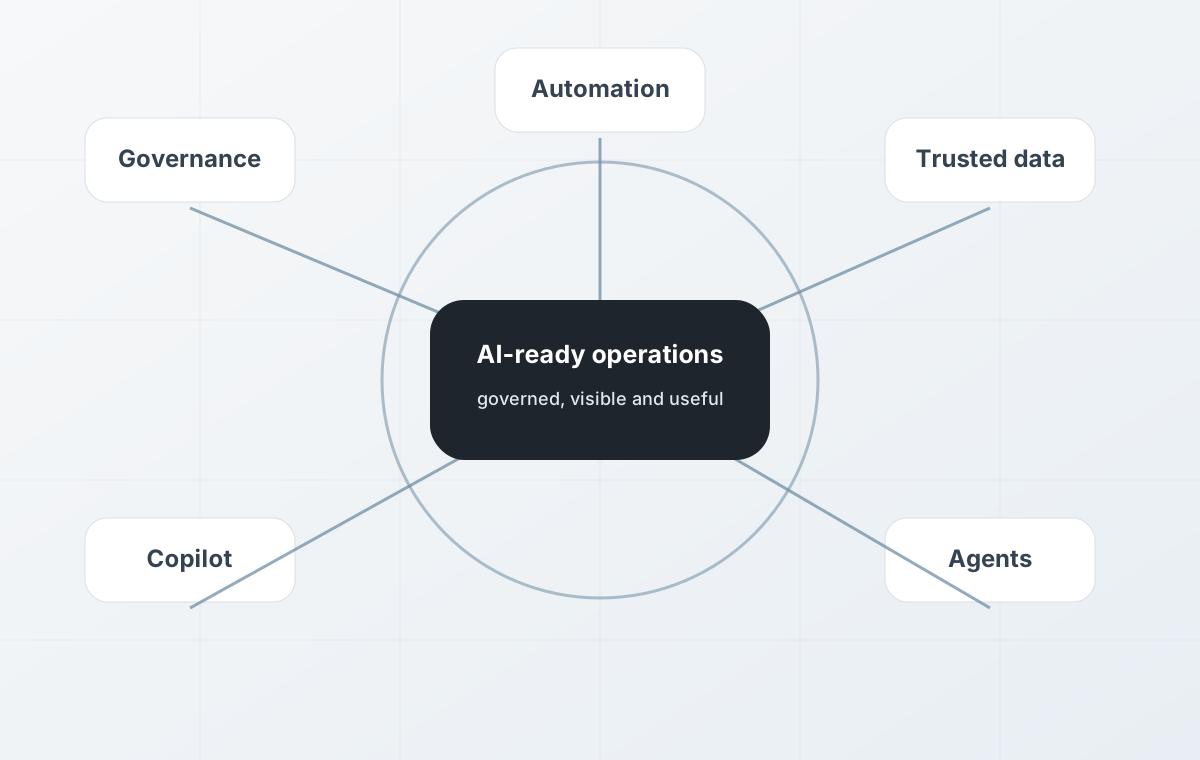
When AI feels close but not safe
The challenge is rarely whether AI tools exist. It is whether the organisation has the data quality, governance and workflow clarity to use them responsibly.
Teams want AI but cannot identify the operational tasks where it should create measurable value.
Knowledge sits across documents, systems, Teams, SharePoint, CRM, ERP and local processes.
Permissions, sensitive information and unmanaged usage need control before AI is enabled widely.
AI assistants perform poorly when they reason across incomplete, duplicated or poorly governed information.
People still bridge gaps between systems, making automation difficult to sustain.
AI initiatives stall because technical deployment is not connected to training, process design and business value.
Where AI creates value
The most successful AI initiatives are usually focused on improving specific operational activities rather than introducing AI everywhere at once.\n\nAI creates the greatest value when it reduces friction, improves access to information and supports repeatable decision-making.
Help teams find information across SharePoint, Teams, ERP, CRM, documents and operational systems without manually searching multiple sources.
Reduce the effort involved in gathering information, identifying trends and producing management reporting.
Support repetitive operational tasks with recommendations, approvals, routing and guided decision-making.
Improve how requests, service activity, communications and operational knowledge are handled across the organisation.
The goal is not to deploy AI. The goal is to improve how work gets done.
Our approach
We design AI adoption around people, process, systems, data and governance rather than treating AI as a standalone software rollout.
Review information architecture, permissions, data quality, processes and candidate AI use cases.
Identify the areas where AI can reduce friction, improve decisions or automate repeatable work.
Define controls, access rules, usage policies, monitoring and safe operating guardrails.
Start with focused, measurable AI use cases that prove value without exposing unnecessary risk.
Extend from isolated pilots into governed AI-enabled operations and continuous improvement.
AI foundations
Many organisations focus on selecting AI tools before understanding whether the operational environment is ready to support them. Successful AI adoption is typically built on a series of connected foundations.
Stable platforms that can be supported, secured and changed.
Systems that share information instead of creating operational silos.
Reliable information with clear ownership, definitions and governance.
A clearer view of what is happening, where work slows down and what should happen next.
Repeatable processes that can be improved, governed and measured.
The governance, access controls and use cases needed for safe adoption.
AI used to improve information access, decisions, workflows and continuous improvement.
Each stage strengthens the next.
Organisations with connected systems, trusted information and clear operational workflows are usually able to achieve significantly greater value from Copilot, AI assistants and agentic automation.
AI succeeds when it is built on strong operational foundations rather than introduced in isolation.
Outcomes
The goal is a business that can use AI confidently because the underlying systems and information are ready.
Policies, permissions and governance reduce the risk of unmanaged or inappropriate AI usage.
AI has access to clearer, better-governed information and produces more useful support for teams.
AI becomes part of workflow improvement rather than a disconnected experiment.
FAQ
Start with operational problems, not tools. Identify the workflows, decisions or information tasks where AI can create measurable value.
No, but you need enough governance, ownership and information quality to avoid unreliable outputs and unmanaged risk.
Yes. We support Copilot readiness, Microsoft-aligned AI governance and custom agentic AI workflows where they are appropriate.
Start with readiness
We can help you understand what needs to be connected, governed and improved before AI is deployed at scale.
Book an AI readiness conversation