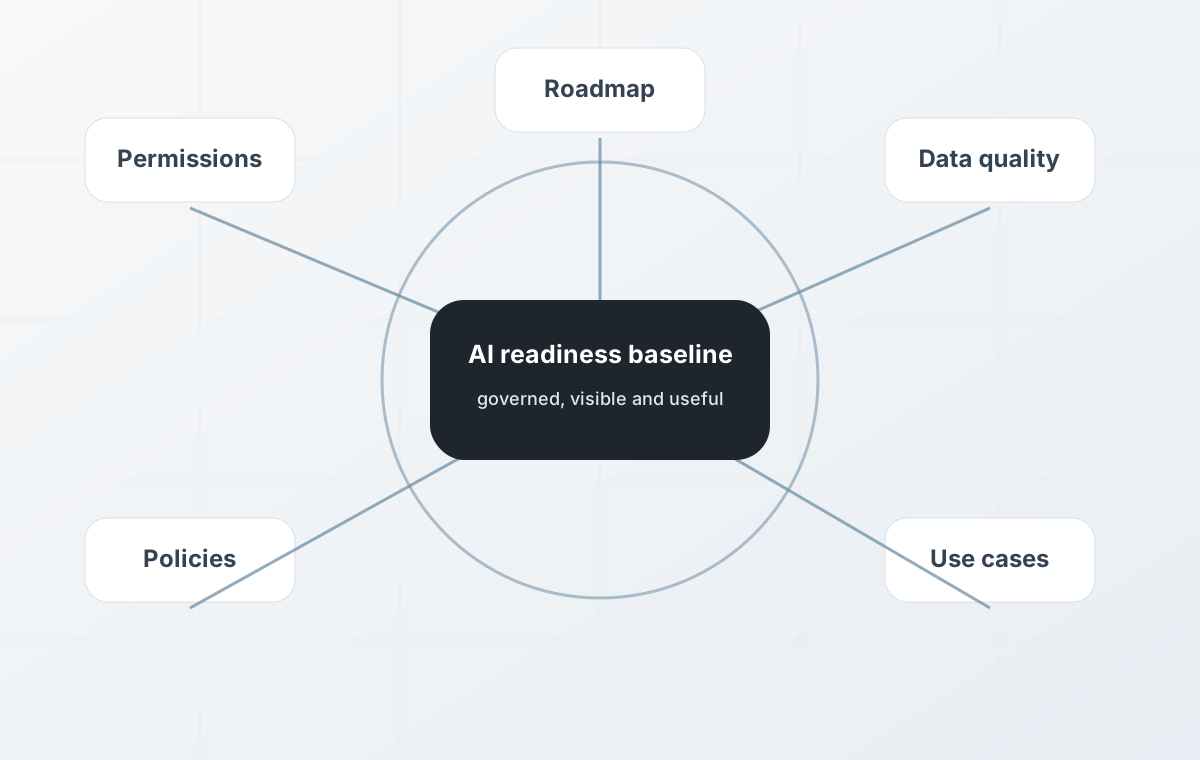
Before investing in AI, check the foundations
Many businesses are interested in AI, automation and agentic workflows, but the best starting point is not always a tool, model or proof of concept.
AI depends on the quality of the systems, data and processes around it. If business information is fragmented, workflows are unclear, systems do not integrate, or governance is weak, AI projects can become expensive experiments rather than useful operational improvements.
System Software helps UK businesses assess whether they are ready for practical AI adoption, where AI could create value, and what needs to be modernised first.
The goal is simple: identify sensible AI opportunities without ignoring the operational foundations that make them safe, useful and maintainable.
When an AI readiness assessment makes sense
An AI readiness assessment is useful when your business sees potential in AI but needs a clear view of what is realistic, valuable and safe before committing to implementation.
It may be time to assess AI readiness if:
- You want to use AI but are not sure where it would create real business value.
- Your data is spread across spreadsheets, legacy systems, cloud platforms and disconnected tools.
- Teams spend time on repeatable research, routing, summarisation, checking, reporting or administration.
- You want to explore agentic AI but need to understand the risks and dependencies first.
- Existing systems do not integrate cleanly enough to support reliable automation.
- You have manual workflows that may be suitable for AI-assisted automation.
- You need better governance, permissions, monitoring or human approval before AI can be trusted.
- You want a practical roadmap rather than a vague AI strategy.
What we assess
We look at AI readiness from a practical business and systems perspective. The assessment is not just about whether AI is possible. It is about whether it is sensible, useful and supportable.
- Business goals and operational pain points
- Current systems, platforms and data sources
- Data quality, ownership, structure and accessibility
- Integration gaps between business systems
- Manual workflows and repeatable decision points
- Opportunities for automation, augmentation or decision support
- Security, permissions and access control
- Human approval, exception handling and audit requirements
- Cloud, infrastructure and monitoring readiness
- Risks, constraints and implementation dependencies
- Potential quick wins and longer-term roadmap items
- Whether AI is the right answer at all
AI readiness is often a systems problem
AI projects often struggle because the underlying business systems are not ready.
If information is trapped in spreadsheets, old databases, inboxes, disconnected applications or poorly governed file stores, AI cannot reliably act on it or learn from it in a useful way.
In many cases, the right first step is not building an AI agent. It is improving data flows, modernising systems, connecting platforms, automating workflows or creating a clearer source of truth.
- Agentic AI when there is a clear opportunity for AI to assist with repeatable actions, routing, analysis or operational tasks.
- Unified data when information is spread across systems and needs to become more reliable for reporting, automation or AI.
- System integration when existing platforms need to share data before AI can use it effectively.
- Custom workflow automation when the main opportunity is to improve repeatable processes and handovers.
- Legacy system replacement when older platforms are blocking automation, integration or reliable data access.
- Cloud and infrastructure when AI, automation or data platforms need a more secure and scalable foundation.
What the assessment can help you decide
A good AI readiness assessment should give you clarity, not just ideas.
- Where AI could realistically help your business
- Which processes are suitable for AI-assisted automation
- Which data or system gaps need fixing first
- Whether a workflow should be automated with software before adding AI
- Where human review, audit trails or approvals are needed
- Which risks need to be controlled before implementation
- What a sensible first AI project could look like
- Whether AI is not the right answer for a particular problem
Practical AI opportunities we look for
We focus on AI opportunities that connect to real business outcomes, not novelty.
Depending on your systems and processes, that may include:
- Document review, extraction or classification
- Customer request triage and routing
- Operational summarisation and reporting support
- Workflow recommendations and next-step suggestions
- Exception detection and escalation support
- Knowledge search across controlled business information
- Internal assistant tools for staff
- AI-assisted data checking or enrichment
- Agentic workflows with clear guardrails and approvals
- Automation opportunities that do not need AI at all
Built for operational businesses
We are especially well suited to manufacturers, B2B service providers, wholesalers, engineering firms and growing businesses where AI needs to interact with real systems, workflows and operational data.
These businesses often have valuable processes and data, but they may also have legacy systems, spreadsheet-heavy workflows and integration gaps that need addressing before AI can be useful.
We help you understand the path from current systems to practical, controlled AI adoption.
Our approach
Understand
We review your goals, current systems, workflows, data sources, pain points and expectations around AI.
Assess
We assess data readiness, integration gaps, process suitability, security, governance and practical AI opportunities.
Prioritise
We identify where AI could add value, what should be fixed first and which opportunities are most realistic.
Roadmap
We provide a practical route forward, which may include AI, automation, integration, data work or system modernisation.
Not every problem needs AI
One of the most useful outcomes of an AI readiness assessment may be discovering that AI is not the best first step.
Sometimes a better integration, dashboard, workflow tool or bespoke system will solve the problem more reliably and at lower risk.
We will help you separate genuine AI opportunities from problems that are better solved through clearer systems, cleaner data and practical software improvements.
Frequently asked questions
What is an AI readiness assessment?
An AI readiness assessment reviews whether your business has the systems, data, workflows, security and governance needed to adopt AI safely and usefully.
Why is AI readiness important?
AI relies on reliable data, connected systems and clear workflows. If those foundations are weak, AI projects can become unreliable, risky or difficult to maintain.
Do we need clean data before using AI?
You do not need perfect data, but you do need to understand where the data comes from, who owns it, how reliable it is and whether it can be accessed safely by the systems that need it.
Can you help us identify AI use cases?
Yes. We help identify practical AI opportunities linked to real business processes, such as routing, summarisation, document handling, operational reporting, workflow support or controlled agentic automation.
What if our systems are not ready for AI?
That is a useful finding. The next step may be system integration, data improvement, workflow automation, legacy modernisation or cloud infrastructure work before AI implementation.
Is this only for companies that want agentic AI?
No. An AI readiness assessment is useful for any business considering AI, automation, internal assistants, data-driven workflows or agentic AI.
Will the assessment recommend AI even if it is not needed?
No. If AI is not the right answer, we will say so. Sometimes a simpler software, integration or workflow improvement is more practical and reliable.
Can the assessment lead into implementation?
Yes. If there is a clear opportunity, the assessment can lead into agentic AI, workflow automation, system integration, unified data, bespoke software development or retained development support.