
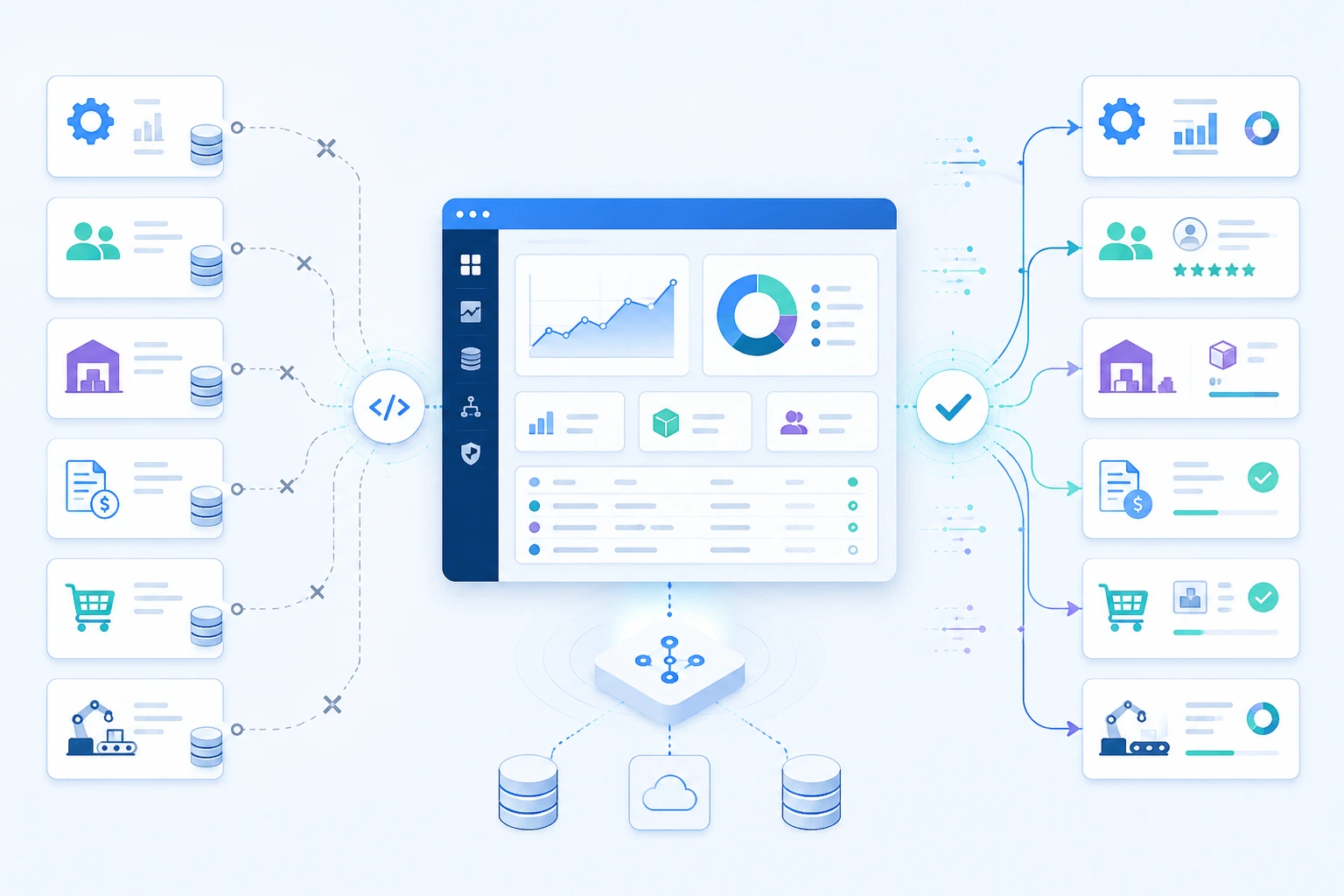
When useful systems do not talk to each other
Many businesses already have systems that do useful work. ERP, CRM, WMS, finance, e-commerce and operational platforms may all support important parts of the business.
The problem is often not that every system is wrong. The problem is that data does not flow cleanly between them.
Teams end up re-entering information, exporting spreadsheets, chasing updates, reconciling reports and building workarounds around disconnected systems.
System Software helps UK businesses connect ERP, CRM, WMS, finance and operational systems through practical, reliable integrations built around how the business actually works.
Signs your systems need integrating
You may not need a new platform. You may need the systems you already use to share information more reliably.
It may be time to review system integration if:
- Data is manually re-entered between ERP, CRM, WMS, finance or e-commerce systems.
- Teams rely on spreadsheet exports to move information between departments.
- Order, stock, customer or invoice data is inconsistent across platforms.
- Reports take too long to produce because data lives in different systems.
- Customer service cannot see order, fulfilment or finance status clearly.
- Warehouse, production or finance teams work from different versions of the truth.
- Existing systems are useful, but disconnected.
- You need better data foundations before automation, dashboards or AI can work properly.
Systems we can help connect
We design and build integrations that help business systems exchange data securely, reliably and in a way that supports real workflows.
- ERP to CRM integration
- ERP to WMS integration
- CRM to finance integration
- E-commerce to ERP or WMS integration
- Order management to stock and fulfilment systems
- Finance, invoicing and payment data flows
- Warehouse, stock and inventory data synchronisation
- Customer, supplier and product data integration
- Legacy system to cloud platform integration
- Reporting and dashboard data feeds
- API development and middleware
- Custom integration layers for operational systems
Integration without replacing everything
System integration is often the best route when your existing platforms are still valuable but the gaps between them are creating manual work, errors or poor visibility.
Instead of replacing every system, we can help create reliable data flows between the tools your business already depends on.
In some cases, integration is the right answer. In others, the better route may be a custom operational system, workflow automation, spreadsheet replacement or legacy modernisation.
- System integration when the main issue is disconnected data between existing platforms.
- Bespoke software development when you need a custom system built around a process that existing platforms cannot support.
- Custom order management systems when order workflows need clearer visibility across sales, stock, fulfilment and finance.
- Custom workflow automation when the main issue is manual handovers, approvals or repeatable operational processes.
- Spreadsheet replacement when people are using spreadsheets to bridge gaps between systems.
- Legacy system replacement when an older system is too risky, limited or difficult to integrate.
What better integration can give you
The aim is not simply to connect systems for the sake of it. The aim is to make business information more accurate, available and useful.
- Less manual re-entry between systems
- Cleaner order, customer, stock and finance data
- Fewer errors caused by duplicated or outdated information
- Better visibility across sales, operations, warehouse, finance and customer service
- More reliable reporting and dashboards
- Faster handovers between teams and platforms
- Stronger foundations for automation, workflow improvement and AI readiness
- Existing systems that work together more effectively
Built for operational businesses
We are especially well suited to manufacturers, wholesalers, distributors, B2B service providers and e-commerce-enabled businesses where data needs to move between operational systems reliably.
That might include order data moving from e-commerce into ERP, stock updates flowing between WMS and customer service, finance information syncing with CRM, or production and fulfilment data feeding dashboards.
We take the time to understand the process, data ownership, system constraints and operational impact before designing the integration.
API-driven where possible, pragmatic where needed
Modern API-driven integration is usually the preferred route. But real business systems are not always clean or modern.
Some integrations involve legacy databases, files, scheduled imports, vendor limitations, middleware, webhooks or staged synchronisation.
We focus on the most reliable and maintainable approach for your environment, rather than forcing a one-size-fits-all integration pattern.
Our approach
Map
We map the systems, data flows, ownership, pain points, users and operational processes that the integration needs to support.
Design
We define the right integration approach, including APIs, middleware, data mapping, validation, error handling and monitoring.
Build
We build and test the integration with senior engineers, keeping the focus on reliability, maintainability and business value.
Support
After launch, we can monitor, support and improve integrations through retained development or planned enhancements.
Suitable project types
We are a good fit for focused integration projects, typically in the £20k–£50k range, and for retained development relationships where integrations need ongoing support or improvement over time.
That could mean connecting ERP and CRM, integrating WMS and e-commerce, improving finance data flows, building an integration layer for operational systems, or creating dashboards fed by multiple platforms.
Frequently asked questions
What is ERP, CRM, WMS and finance system integration?
It is the process of connecting business systems so they can share data reliably. This can reduce duplicate entry, improve reporting and give teams a clearer view of customers, orders, stock, fulfilment and finance.
Do we need to replace our existing systems?
Not always. If your existing ERP, CRM, WMS or finance systems are still useful, integration may be a better route than replacement. The aim is to make systems work together more effectively.
Can you integrate legacy systems?
Yes, where practical. Some legacy systems can be integrated using APIs, database connections, file exchanges, middleware or scheduled synchronisation. If the system is too risky or limited, legacy replacement may be the better option.
Can integration reduce spreadsheet work?
Yes. Many spreadsheet-heavy processes exist because systems do not share data properly. Better integration can reduce manual exports, copy-and-paste updates and spreadsheet-based reconciliation.
Can you build dashboards from integrated data?
Yes. Once data flows are reliable, we can help build dashboards and reporting views that combine information from ERP, CRM, WMS, finance, e-commerce or operational systems.
Is system integration useful before automation or AI?
Yes. Automation and AI usually depend on reliable systems and clean data flows. Integrating systems can create a stronger foundation for workflow automation, analytics and AI-assisted operations.
How much does system integration cost?
Cost depends on the number of systems, integration method, data complexity, vendor limitations, testing needs and support requirements. Focused integration projects often sit in the £20k–£50k range, with retained development available for ongoing support.